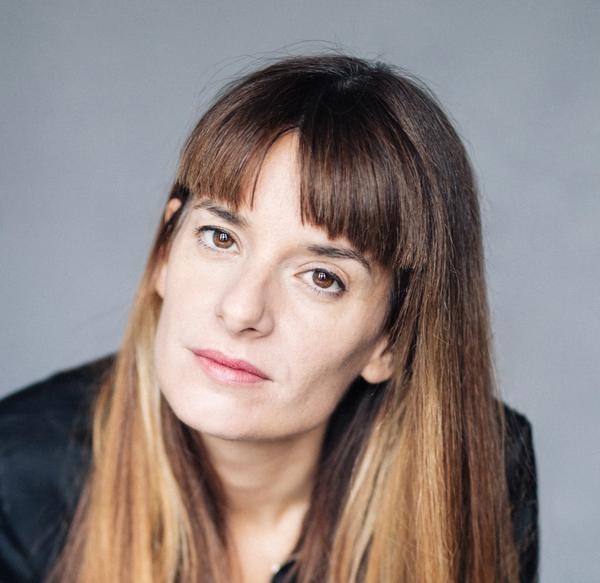
Jaha Koo
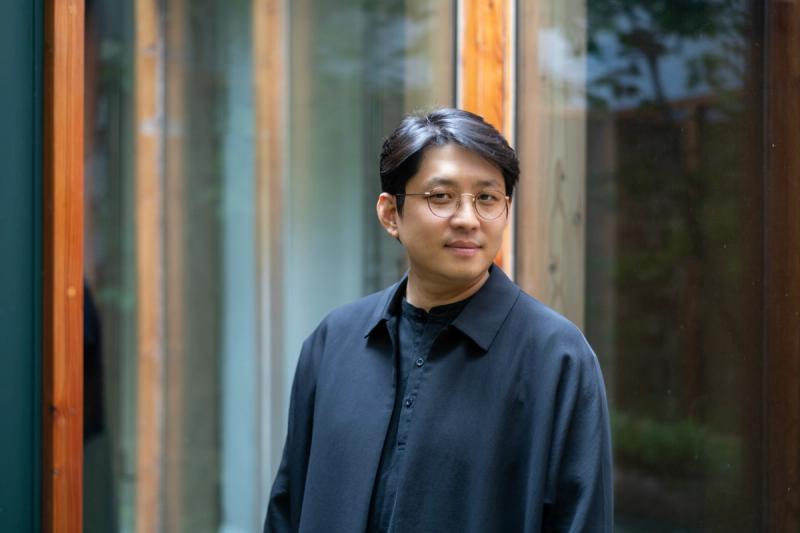
Jaha Koo is a South Korean theatre maker, composer, and video artist whose practice spans multimedia performance and technology.
The Committee Statement
In a world too often positioned through the ‘for’ and ‘against’, The International Ibsen Award 2026 rewards the imagining of theatre as the space in-between - as a site for assembly, a place to envision and inspire what we might not yet know.
The practice of theatre made through compassion and kindness, so critically needed for our times.
The experience of art as a reminder of the human capacity to nurture and share beauty, hope and joy, as new ways of being and seeing.
Theatre forging time and space for the reflection of the ongoing quiet works that are democracy in action. This vision is personified in the world of South Korean theatre and performance maker, music composer, and video artist Jaha Koo.
In a world where bigger and louder are often equated with best and usually lauded, Jaha presents alternative ways of seeing the world. He eschews the loud and the bombastic in favour of the intimate, the delicate and the small: almost akin to an elegant chamber orchestra, but often providing sharp socio-political critique and expansive reflections on identity, displacement, and the erosion of democracy.
His theatre is shaped by translocation: the journey between Seoul and Ghent — where he now lives and works; by histories of colonialism and the unexpected personal impact of imperialism; by a searching look at possibilities and hopes. His work is never about being a hostage to the past but rather a means of understanding its complexities and lasting impact in shaping the present he inhabits. He envisages possibilities that allow audiences to see beyond the trappings of their current conditions, succinctly refracted in the magical stage worlds he creates.
Jaha’s journey as an artist began with music but this led him to discover the joys in the possibilities of theatre. However, he found the conventions of making theatre too restrictive. As he explained in an interview for Festival TransAmériques, ‘I’m a theatre creator, but I’m also a musical composer and a videographer. How to handle different artistic languages within my creative work is a question I’m always exploring … I want to invent a new, unique form that will allow me to encompass every facet of my identity [and] since 2014, I’ve set myself the goal of finding a theatrical form that goes beyond a lecture or documentary’.[1]
This vision of the potentialities of theatre is encapsulated in the Hamartia Trilogy, which Jaha develops between 2014 and 2020, focusing on how our irrevocable past leaves its mark on the future. In Greek, hamartia means tragic flaw or error in judgement, these pieces about unequal histories are never refashioned as lehrstück or lesson but rather playful and layered. This trilogy is an insightful long-term exploration of the political landscape, colonial history, and cultural identity of East Asia.
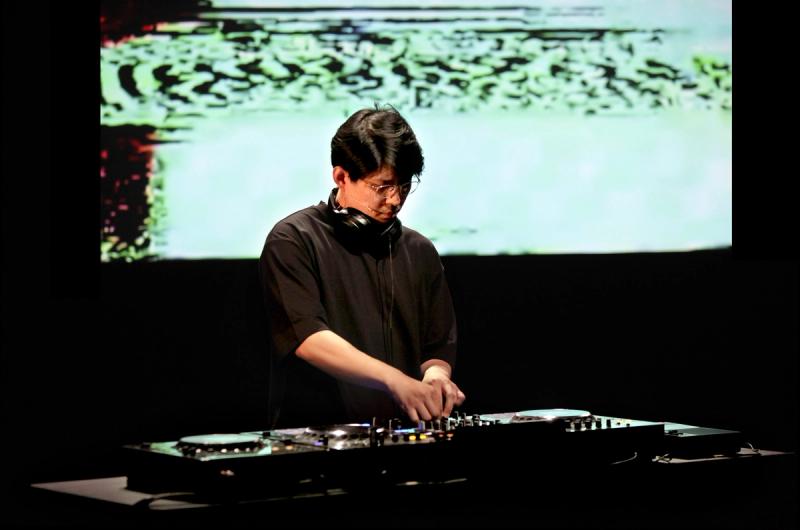
Beginning with Lolling and Rolling (2015), he examines why many parents in South Korea obsessively impose the English language on their children, to the point of having some undergo major tongue surgery to improve their pronunciation especially the differentiation of the letters ‘l’ and ‘r’. The work cleverly navigates English as an additional language. English may be the dominant world language, but its influence and status are as a non-parental language, one whose history is steeped in political coercion and the legacy of empire. It precisely shows, with wit and verve, how practices of what is valued in South Korea are shaped by western imperialism.
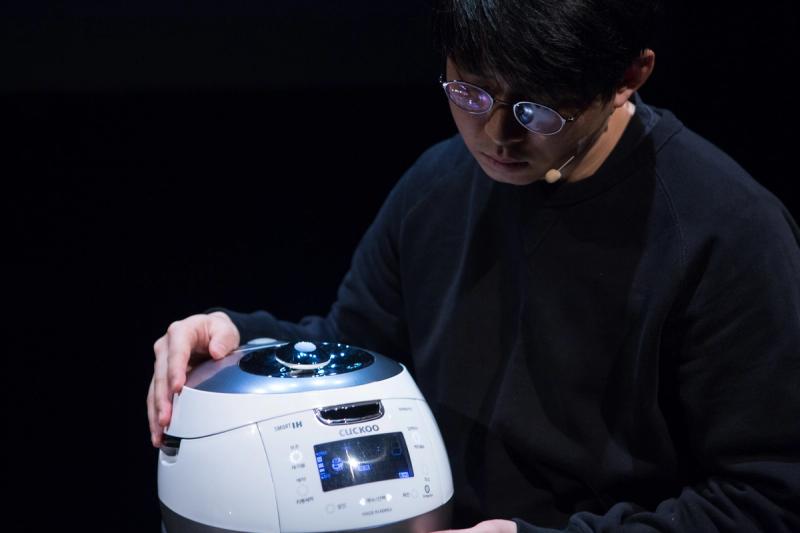
Experience Jaha Koo's play Cuckoo at the National Theatre of Norway 27 September
In Cuckoo (2017), the artist engages in a conversation with his talking rice cookers, through hacking the voice commands and notifications. This results in bittersweet and humorous dialogues through which they go on a journey through the last two decades of Korean history. Twenty years ago, there was a major economic crisis in South-Korea, comparable to the financial crash in the United States and Southern Europe in 2008. This crisis had a huge impact on the young generation. He witnessed many endemic problems including youth unemployment and socio-economic inequality. Rising suicide rates, isolation, acute social withdrawal, and a fixation on personal appearance are but a few of the symptoms. Here, he deploys words that are untranslatable, as with ‘Golibmuron’ (고립무원), a Korean word expressing the feeling of helpless isolation that characterizes the lives of many young people in Korea today. The multilingualism that he prioritises on stage challenges linguistic imperialism. Offering modes of being that recognise the challenges and complexities of inherited value systems, he reminds an audience of the slippery and mysterious nature of language. Not everything can be translated or matched. It is in these gaps — the spaces between — that Jaha Koo’s theatre exists.
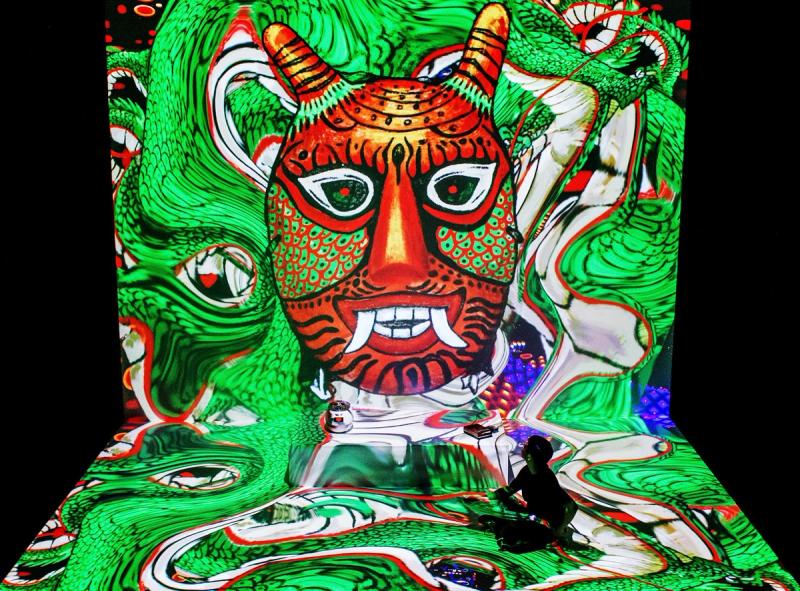
In The History of Korean Western Theatre (2020), the third part of the trilogy, he reflects on how Western theatre was imported into his country and was able to replace traditional theatre forms. Navigating shifting perspectives and different ways of seeing, he combines history with a consideration of what the future might hold. The History of Western Korean Theatre reminds audiences that history is never neutral but rather constructed through processes that are complex and shaped by selection and interpretation.
Meticulously, he exposes the tragic impact of the past on our lives, unveiling the small cracks in modern Confucianism - an ideology that continues to define the moral system, way of life and social relations between generations in South Korea. With a new generation of South Koreans in mind, he attempts to break with a tradition full of self-censorship and the keeping up of appearances. Because only when based on an embodied and lived understanding of history, he can pass on a future to the next generation.
His work is often funny and engaging, occupying a space between the hyperreal and the absurd. His theatre is unafraid of dismantling genres and playing with conventions. His work has deep resonances with generation Z: young people for whom the digital is the real.
This constant navigation and existence in the in-between allow Jaha the space and scope to transcend the rigid locus of any fixed identities. As he explained in an interview ahead of an appearance at Vancouver’s PuSh International Performing Arts Festival, whenever he now returns to Korea he feels as if he is viewed less as a Korean person, and more as ‘an international person with a Korean background’. And yet conversely when in Belgium he senses that Europeans look upon him as ‘distinctly Korean’, as a result Koo asks ‘Am I still Korean? That is my question these days’.[2]
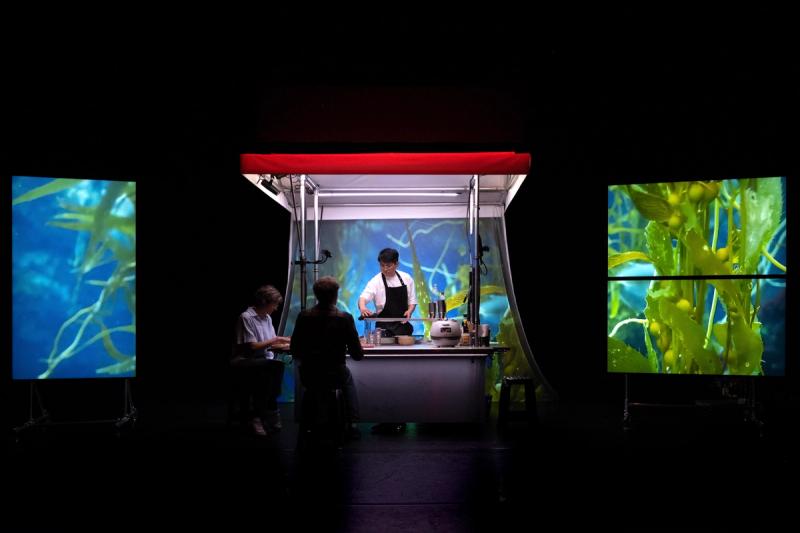
This richly interdisciplinary and inventive approach to theatre making also extends to include Automation.Only this is not object theatre in the way it might have been traditionally understood, rather a theatre of dexterity and surprise. The mundane and the domestic are reshaped with objects acquiring an animated importance, as with the robotic singing rice cookers in Cuckoo or the origami toad in The History of Western Korean Theatre and, in Haribo Kimchi (2024) a robotic eel, the most sophisticated and complex robotic object he has created to date. Objects acquire a new life on stage, agents in the storytelling that reflect with wit and imagination on the times. Cuckoo may be a deliberation on Western intervention into South Korea’s economic crisis in 1997, but it is also a reflection on home, on the ways in which the political plays out in the personal space with real life impact on human beings.
In Jaha’s journey of creating new forms of theatre, collaborators are also central to his ways of working. Life partner and regular collaborator Eunkyung Jeong, a South Korean scenographer, visual artist and writer, are vital interlocutors to this process of invention and innovation. Similarly, long time dramaturg Dries Douibi is a critical presence across his entire body of work. Jaha’s theatre is one where the audience is also a vital component. In the Hamartia Trilogy and his latest piece Haribo Kimchi, we the audience never once feel like we are outside the world he creates. He gently but firmly invites you into the worlds he sets up. This penchant for gathering and coming together is also what makes his theatre profoundly human. In Haribo Kimchi, audiences are brought together through acts of assembly where he created a pojangmacha, a late-night snack-bar on stage, returning to the motif of food as the site for identity formation, a space for congregation and togetherness. ‘My work’, he noted in a 2025 interview when touring Haribo Kimchi to Seoul, ‘speaks about Korea, but audiences overseas tend to see their own stories in it’[3]– an experience that is at once highly political given the propensity of division and difference, as well as intimately personal.
Hence, the political dimensions of Jaha’s works are never framed through shouting. He has the incredible ability to cut through the noise of ideology and platforming to cultivate a theatre of the quiet. These works have a delicacy where the power of the performance often creeps up on you as a spectator. The work is deftly political without ever appearing angry or aggressive.
His is a theatre that feels uniquely experiential and immediate. To see a work by Jaha Koo is to leave the theatre smiling, filled with questions and new curiosities. A theatre to make you think, to be inspired, to leave knowing that there is more to look forward to.
Jaha Koo is the first recipient of Asian descent to win the International Ibsen Award.
[1] Anon. ‘Who is theatre-maker Jaha Koo?’, South Bank Centre Magazine, 19 February 2025